

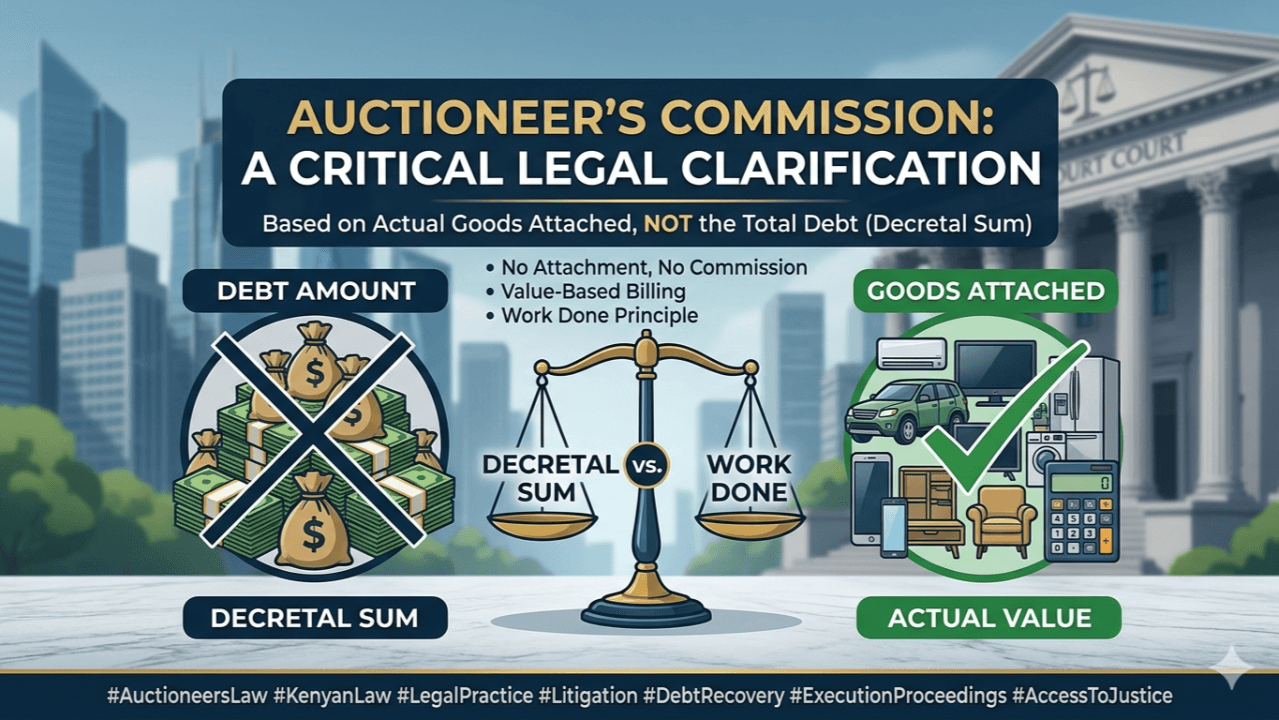
An Auctioneer's Commission Is Calculated Based on Actual Goods Attached and Not the Debt Amount

How are the auctioneer fees calculated?
If an auctioneer receives a letter of instruction or a court warrant but does not carry out an attachment or a sale, their entitlement to fees is significantly limited. Under the Auctioneers Rules, 1997, fees are generally tied to the work actually performed and are based on goods which are proclaimed and attached.
2. No Proclamation or Attachment No Commission
If the auctioneer has not reached the attachment stage and the debt is cleared, they cannot bill for commission. However, they can typically only bill for:
Instruction Fees: A flat fee for accepting the instructions and opening the file (usually a few thousand shillings).
Service Fees: If they physically served the warrant on the debtor, they can charge for that service and the related transport.
Disbursements: Any actual costs incurred, such as filing fees paid to the court or search fees at the land/motor vehicle registry.
For example, when the auctioneer only sends warrants, which is essentially receiving the instruction and perhaps opening a file or serving a notice, and the debtor pays the decretal sum, the auctioneer is not entitled to a commission.
It is the case that commission varies depending on whether the property is sold or whether the attachment or repossession is stayed, postponed, or money is tendered after the attachment or repossession but before the sale. It is crucial to look at the calculation and ensure that the correct percentage and formula have been used in the calculation of the auctioneer fees.
3. the No Proclamation or Attachment, No Commission Rule
As a general principle, an auctioneer is not entitled to a percentage-based commission (like the 10% or 5% mentioned earlier) unless they have at least proclaimed the goods.
Judicial Principle is that the fees and commissions by an auctioneer are based on the value of goods proclaimed or attached. In National Industrial Credit Bank Limited v S.K. Ndegwa Auctioneer (1) eKLR, the Court of Appeal held that an auctioneer’s charges should be based on the value of the goods attached, not the total debt (decretal sum). If no goods were attached, there is no value upon which to base a commission.
If an auctioneer seeks to charge commission based on the total decretal sum (say Kshs. 2,000,000), yet they have only proclaimed or attached goods worth Kshs. 500,000.00, the auctioneer fees will be unlawful.
The auctioneer's billing must be pegged to the work done. If the auctioneer has not proclaimed property, they are only entitled to nominal administrative fees (instruction fees) and out-of-pocket expenses.
For example, when an auctioneer sends a proclamation but does not attach the goods, they cannot bill for transport, security, storage, or associated costs. This is because that is work which has not been done.
4. Proclamation Equal Attachment
The courts will allow an auctioneer to earn commission as long as they have proclaimed the goods. Once an auctioneer follows the procedure under Rule 12(b) of the Auctioneers Rules and serves a proclamation notice, the goods are considered legally attached and seized by the law, even if the auctioneer does not physically remove them from the premises.
The basis for the commission must be calculated based on the actual value of the goods attached and should not be based on the total decretal sum.
The court rejected the practice of charging commission on the total debt, noting that an auctioneer should only be paid for the specific assets they have successfully brought under the custody of the law.
In the case of National Industrial Credit Bank Limited v S. K. Ndegwa Auctioneer, the court held that:
“I hold that under our laws today once goods or property have been proclaimed under rule 12 (b) and the prescribed procedure followed, the process of attachment takes effect and it does not subsequently matter at what stage it is terminated once goods are proclaimed they become attached and seized by the law.
The auctioneer from this stage is entitled to charge his commission under Rule 11 paragraph 4”.
5. Protection Against Phantom Fees
If an auctioneer sends you a high bill for a warrant they never executed, you have the right to make a request for a Taxed Bill of Costs. The auctioneer is required to present their bill to the Court Registrar (Taxing Master) to prove the work was done. If the auctioneer taxes based on an amount that is higher than the value of the goods attached, you can challenge their bill and have it reviewed by the Taxing Master. This can happen if they levy fees based on a decretal sum, yet the value of the goods attached is significantly less.
In Oscar Otieno Odongo t/a Odongo Investment Auctioneers v Diamond Trust Bank Kenya Limited (Civil Appeal 127 of 2021) (2) KEHC 15050 (KLR) (31 October 2022) (Judgment), the court reaffirmed that fees are confined to the Fourth Schedule and must be based on the actual value of goods attached. It explicitly stated that the auctioneer is remunerated for the work actually performed, and not hypothetical scenarios based on the debt amount.
Further in Kindest Auctioneers v Orbit Chemicals Industries Limited (Miscellaneous Appeal E038 of 2023) (3) KEELC 21782 (KLR) (13 November 2023) (Ruling), the Taxing Master has assessed the Bill based on the value of the goods attached, about (Kshs. 1,966,846.52. The court dismissed an appeal against a Taxing Master’s assessment, upholding the principle that the commission of an Auctioneer is to be based upon the value of goods attached and not on the decretal sum.
Opportunity Kenya v Wanjalal t/a Mako Auctioneers (Civil Appeal 67 of 2020) (4) KEHC 3296 (KLR) (19 March 2024) (Judgment), the court remitted a bill of costs for reassessment, reiterating that a Taxing Master must provide clear reasons and ensure that fees are tied to the actual value of goods attached rather than an arbitrary percentage of the decretal sum.
6. Key Takeaway
The law on auctioneer’s fees is neither abstract nor discretionary. It is structured, evidence-based, and firmly anchored in the work actually performed. The jurisprudence emerging from Kenyan courts consistently affirms a single, controlling principle: commission is earned on attachment, and calculated strictly on the value of the goods attached, not the decretal sum.
An auctioneer cannot convert a mere instruction, service of process, or unexecuted warrant into a revenue-generating exercise through inflated or speculative billing. Without proclamation, there is no attachment; and without attachment, there is no legal basis for commission. Even where attachment is effected through proclamation, the valuation of the attached goods remains the ceiling upon which any commission must be computed.
The courts have also drawn a clear line against phantom fees, reinforcing the role of the Taxing Master as a gatekeeper to ensure that auctioneers are compensated fairly, but only for verifiable work done within the framework of the Auctioneers Rules, 1997.
Summary
- No Attachment, No Commission: An auctioneer’s entitlement to commission only arises upon proclamation or attachment.
- Value-Based Billing: Commission must be calculated based on the actual value of goods attached, not the decretal sum.
- Work Done Principle: Fees are strictly tied to demonstrable actions such as instruction, service, or attachment, not assumptions or anticipated outcomes.
- Proclamation is Sufficient: Legal attachment occurs upon proper proclamation under Rule 12(b), even without physical seizure.
- Right to Challenge Fees: Parties retain the right to demand taxation of a bill of costs and challenge any fees that are excessive, unsubstantiated, or improperly calculated.
Disclaimer: This publication is for general information only and does not constitute legal advice. Specific advice should be sought for individual circumstances.
Share this article
Need expert legal guidance on this topic?
Get In Touch