

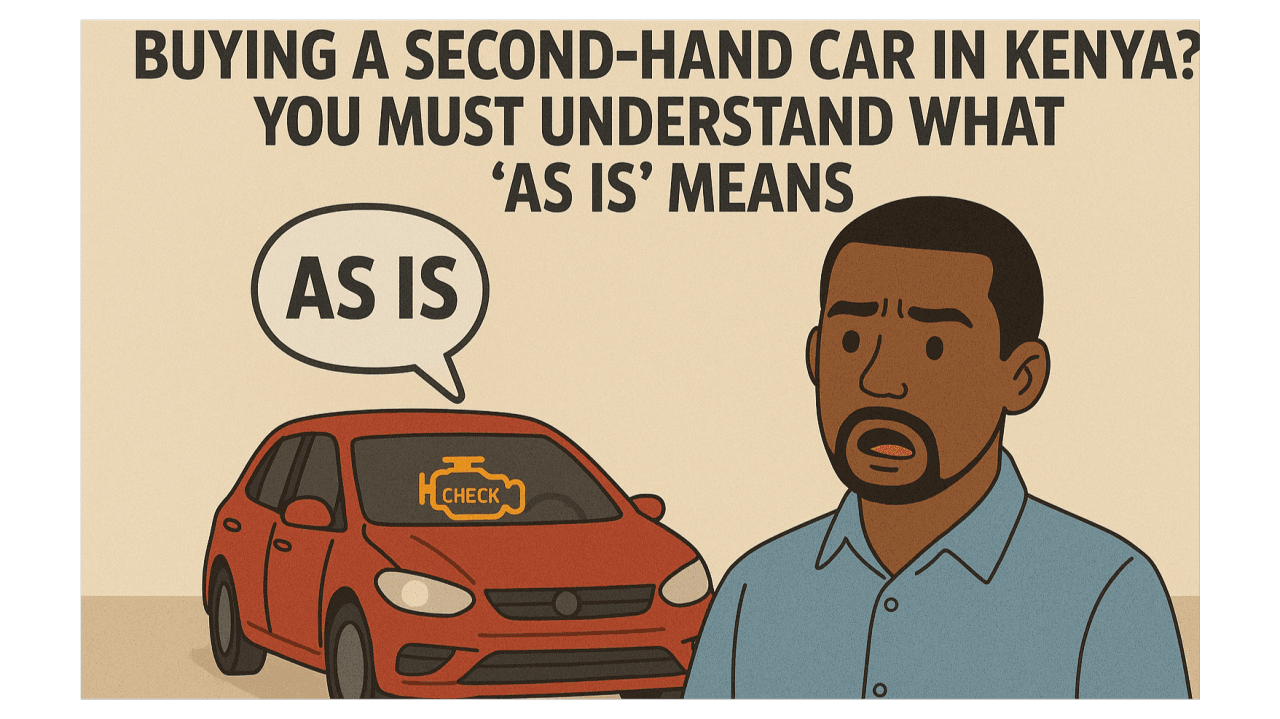
Buying a Second-Hand Car in Kenya? You Must Understand What “As Is” Means

Read before you buy a second-hand car!
Nairobi, Kenya.
Purchasing a second-hand car may be a daunting experience. You may buy a car only to find out that the car odometer has been tampered with and it has a check engine light with multiple faults that were not there a few minutes before the purchase. While a second-hand car purchase is often cost-effective and affordable, a buyer must know various terms which are used in the motor vehicle purchase contract. One phrase buried, which is often hidden in the agreement, is “as is”. This clause can limit your ability to seek a refund or repairs for a faulty motor vehicle.
What Does “as Is” Mean?
The phrase “as is” means the buyer accepts the item in its present condition, with all defects which are hidden or visible. Therefore, once the buyer executes the sale agreement containing this clause, he or she agrees not to hold the seller responsible if problems arise later.
Where “as Is” Comes from – the Common Law Position
The term “as is” has its roots in English common law. The term is a reflection of the famous rule of caveat emptor, which means 'buyer beware'. Whereby, under this doctrine, the buyer is expected to inspect and examine the goods before purchase and bears the risk if they turn out to be defective. The buyer is also obligated to conduct due diligence before a purchase.
The rule has the following effect:
- Limiting the liability of the seller for problems and defects which the buyer discovered after the contract, unless the seller intentionally concealed known defects. For example, interference with the ECU to erase check engine warnings or interference with the odometer will not be protected under the “as is” principle.
- No warranty – the sellers will always disclaim any warranties, implied or express, about fitness for purposes or condition of the vehicle.
- Buyer beware – the principle warns the buyer and hence puts the buyer on notice to inspect the vehicle thoroughly and satisfy themselves as to the conditions of the vehicle before purchase. When the agreement has an “as is” clause, make an effort to engage a certified mechanic or technician if a mechanical problem is not visible.
A physical inspection may not uncover certain issues.
- There could be electrical issues such as deletion of the EGR (Exhaust Gas Recirculation),
- There may be interference with aspects such as the safety airbag, belt lights and car safety warning systems.
- More commonly, there may be meddling with the odometer whereby the distance the car has covered is tampered with.
- The safety and warning systems may have been tampered with.
- Some cars may have an electrical safety bypass system whereby key components of the car may be wired directly to the battery and bypass the car's fuse box, leading to battery drains overnight.
These modifications are very hard to discover by mere physical inspection. Other modifications, like aftermarket seats and ECU remaps, may create safety issues with the car when not done properly. For example, some aftermarket seats will not work with the factory safety warning systems, such as seat belt warnings. Changing the steering wheel to an aftermarket one may leave the car without the steering airbags.
Some modifications like exhaust downpipes, muffler delete, and removing the catalytic converter for increased power may make the car unlawful to drive on the road because of noise and pollution, respectively.
How Courts Have Dealt with “as Is” Clause in Kenya
The Sale of Goods Act (Cap. 31) Section 16 of this Act reflects the caveat emptor principle, stating that “There is no implied warranty or condition as to the quality or fitness for any particular purpose of goods supplied under a contract of sale.” Hence, unless the buyer tells the seller the specific purpose for which the goods are required or unless an express warranty is given, the seller owes no duty to guarantee quality.
The Consumer Protection Act, 2012
When buying from a licensed dealer, however, the Consumer Protection Act gives more protection. Section 55 outlines that “The consumer has a right to expect that the goods are of merchantable quality, fit for the purpose, and durable, unless the goods are sold under the condition that they are used, defective, or not fit for use.” This means that while “as is” limits liability, it cannot be used to cover up dishonesty or breach of duty.
Over time, courts have recognised that this rule is harsh and have limited its reliance and application. Thus, exceptions developed where sellers could be held liable for:
- Fraud and Misrepresentation – while these clauses are enforceable, the courts will not protect a seller if there is intentional misrepresentation or fraud which causes concealment of a material fact or a known defect.
- Breach of an express warranty – courts will interpret the “as is” clause based on the other contractual terms, as well as the specific circumstances of the agreement and purchase.
Case Law
Best Cars Limited t/a Impact Motors v Omoke & another (Civil Appeal E409 of 2023) (1) KEHC 474 (KLR) (Civ) (23 January 2025) (Judgment), being an appeal from the judgment of D.S. Aswani (Adjudicator) (RM) Small Claims Court delivered on 25th May, 2023 in Nairobi Milimani SCCC No. E7883 of 2022
The trial magistrate awarded the plaintiffs Kshs. 400,000 for the breach of contract, mental anguish, unnecessary inconvenience, emotional distress & loss of legitimate expectation; special damages to the tune of Kshs. 400,000; a declaration that the defendant's misrepresentation of the faulty vehicle to be in perfect working condition and/or merchantable quality constitutes a breach of the agreement of sale between the parties; costs of the claim; and interest rates until payment in full.
This decision was arrived at even though the seller (car dealer) had an agreement which had an “as is” clause.
The grounds for the judgment and award were that the defendants had intentionally and malevolently sold the suit motor vehicle, misrepresenting it to be in perfect working condition and/or merchantable quality despite knowing this to be false.
On appeal by the sellers, the magistrates' decision was upheld. Because the buyer had not carried out a proper road test, it was hard to detect any mechanical defects on the car. The fact that the mechanic inspected the car and conducted a miniature test drive at the point of sale was not enough to absolve the car dealer.
In the words of the judge:
Thus, a proper road test would have been warranted in the circumstance on accord of an implied condition that the vehicle was of merchantable quality or sold as it is whereas the limited examination of the vehicle as argued by the Appellant did not waive the implied condition of defects which could not be reasonably revealed upon the limited examination and or test drive. Consequently, the trial Court cannot be faulted at arriving at the decision it did whereas it is evident that the learned Magistrate considered the entirety of the provisions of Section 16(b) of the Sale of Goods Act.
Car dealers and sellers should know that:
- Without allowing a proper test drive, a car seller will find it hard to rely on the 'as is' clause.
- An opportunity to test drive the car is required; allowing the buyer only a miniature test drive will not absolve them from liability.
- If there are conditions which prevent the buyer from testing the car on the highway, such as the car lacking insurance, the seller cannot state that the buyer had the opportunity to test drive the car.
- The seller should avoid limiting the inspection of a motor vehicle by a buyer. This could lead to liability in case of defects which are discovered later on, especially if those defects are hidden defects.
Practical Implications for Car Buyers
When buying a car sold “as is”:
- You accept the vehicle with all faults.
- You carry the risk of a mechanical or legal problem.
- You cannot rely on trust—get everything in writing.
- Your options may be limited if something goes wrong, unless the seller lied.
How to protect yourself as a car buyer
Don’t rely on verbal promises. Ask for everything in writing.
In writing, enquire about key details such as odometer reading, catalytic converters, previous accidents, aftermarket modifications (mods), etc.
Conduct a full inspection—ideally with a qualified mechanic. An inspection by a qualified mechanic may not be enough. You may need to have a car electrician or technician access the ECU and look at the history of the car and all fault codes which have been cleared recently. Many cars like BMW, Merc and Audi store fault code history. You may have a good idea of the condition of the car when you see that it has so many fault codes which had been cleared previously.
For example, a car with fault codes showing timing chain codes may point to a problem with timing chains. Knowledge of such a fault code will allow you to enquire whether the timing was set or whether the timing gears were changed and set.
A car with a history of fault codes showing airbags may point to a recent accident or underlying problems with airbag sensors.
Check for logbook ownership, accident history, and service records.
When buying overseas imported cars, search the VIN or chassis number to verify that the car was not reported stolen. If the car is imported from countries like the UK, you can use platforms like Car Vertical, etc., to check the history of the car, including service, accidents, inspections, etc. Check the country of origin for the car and undertake appropriate searches.
Ask if the seller is a licensed dealer. Dealers are bound by stricter laws.
Consult a lawyer before signing anything, especially if terms like “as is” appear.
Key takeaway
The phrase “as is” may seem like harmless legal jargon, but it can block your ability to seek redress when the car you buy is faulty or has a problem. When a seller refuses your efforts to inspect the car, it is advisable to avoid the purchase. This applies to any machinery or equipment purchased second-hand without any warranty or guarantee.
Whether you’re buying from a car yard or a private individual, always read the contract and seek legal advice. In addition, make sure to inspect the vehicle and test drive the car extensively before purchase. Some fault codes (such as a faulty or missing catalytic converter), when cleared, can take even a day to reappear. Taking the car for a long drive for a day and pushing the car to the limits is recommended before purchasing.
Disclaimer: This publication is for general information only and does not constitute legal advice. Specific advice should be sought for individual circumstances.
Share this article
Need expert legal guidance on this topic?
Get In Touch