

Derivative Actions by Minority Members and Shareholders of a Company

What is shareholder derivative action?
Shareholders may institute a legal suit on behalf of the company against directors for breaches of duty, fraud, or negligence. Derivative actions are governed by Part XI (Sections 238–242) of the Companies Act, 2015. These sections codify the circumstances under which a member can step into the company's shoes to litigate a cause of action that belongs to the company.
This allows a shareholder to bring a legal claim on behalf of the company for a cause of action vested in the company. It is typically used when a company has suffered a wrong, such as negligence or a breach of duty by directors, but the majority refuse to sue.
1. Derivative Action
Before the court allows a derivative action, the shareholder is required to first seek leave of court. This means the derivative claim is a two-stage process, the leave stage and a main claim. Unlike the old common law regime, a member must now apply for the High Court’s permission to commence a derivative claim or take over a claim. Thus, a shareholder should have serious and compelling reasons before approaching the court to institute a derivative action.
Application for Permission is governed by sections 239 and 241, which provide that:
- Section 239: The member must apply to the High Court for permission (leave) to continue the claim.
- Section 241: The Court must refuse permission if: (a) A person acting in accordance with the duty to promote the success of the company (Section 143) would not seek to continue the claim; and (b) the act or omission has been authorised or ratified by the company before or since it occurred.
The statute allows a member to apply to be substituted under section 242. The court can also allow a member to take over a claim originally brought by the company if the following conditions are satisfied: the member making an application:
- The company's manner of pursuing the claim is an abuse of the process of the court.
- The company has failed to prosecute the claim diligently.
- It is appropriate for the member to continue the claim as a derivative action.
The criteria are for the court to consider whether the applicant is acting in good faith and if the action is in the company’s best interests. The High Court of Kenya exercises significant discretion in granting leave (permission) to a shareholder to pursue a derivative action. The court’s primary objective is to filter out frivolous litigation while ensuring that genuine wrongs against the company are redressed.
The court will typically approve or allow a derivative action to continue after the shareholder meets very specific criteria. The case of Joseph Munyoki Nzioka v Raindrops Limited & 3 others (1) eKLR outlines all the requirements and tests which must be met for a derivative action to be allowed by the Judge:
- Be a member or shareholder of the Company or a person who is not a member of the Company but to whom shares in the Company have been transferred or transmitted by operation of the law;
- The proceedings before the court must be in respect to a cause of action that is vested in the Company;
- The proceedings in question must be seeking relief on behalf of the Company;
- The proceedings must concern a claim arising from an actual or proposed act or omission which involves the negligence, default, breach of duty (such as fiducial duties), or breach of trust by a director of the company.
While Section 238 (Derivative Action) and Section 780 (Unfair Prejudice) are often filed together, they are distinct. A derivative action seeks a remedy for the company, while an unfair prejudice claim seeks a remedy for the individual shareholder. While they are separate tracks, the court can order a derivative action to proceed as part of an unfair prejudice petition under Section 238(2)(b).
1.1. Proof of a Prima Facie Case
The applicant is required to prove that he or she has a cause of action that has reasonable success prospects. This ratio can be found in the case of Isaiah Waweru Ngumi & 2 others v Muturi Ndungu (2) eKLR, where the judge held that for the High Court to grant leave and allow a derivative action, the shareholder must have precisely particularised the allegations. When the allegations disclose misconduct like corporate mismanagement or waste of assets, revealing a sufficient cause of action that will benefit the company if proven, then the court will most likely make an order granting leave to allow a derivative action.
1.2. Actions Involving Fraud on the Minority
While the 2015 Act moved away from the more rigid common law exceptions approaches, the courts will more likely intervene and allow derivative claims when:
- The wrongdoers are in control of the company, for instance, as directors of the company or controlling shareholders: If the directors or majority shareholders (or both) who are liable for committing the wrong are the same people who are refusing to allow the company to sue, the courts will most definitely intervene. This situation brings a compelling rationale for the Judge to interfere and allow the derivative action on behalf of the company. For instance, when a director diverts company funds, but he controls the majority as a shareholder and hence uses the control to avoid any liability to restitution of company property.
- Breach of Fiduciary Duties under the Act or Common Law: This is a cause of action that arises out of the acts or intended proposed action of the directors. The main category of causes of action pertains to breach of duty, breach of trust, negligence or default by directors under Section 238(3).
1.3. Promoting the Success of the Company
The Judge is required to apply a hypothetical director test (as per section 241). The court will reject the derivative claim when it is shown that a person acting in a manner that aligns with the duty of promoting the company's success (as per section 143) would not have continued with or brought the claim.
If the Judge determines that a reasonable director of the company would consider the litigation as being beneficial to the long-term business interest of the company, the court will most definitely approve the derivative claim.
1.4. Failure of Internal Mechanisms
Internal management mechanisms play a very important function in the running of the affairs of the company. It allows the shareholders and the directors to settle disputes and deal with deadlock. However, if the member of the company is able to prove that the company failed to address or pursue the case properly using the board or the internal mechanisms of dispute resolution, then the court is likely to approve the derivative claim.
Some of the examples where this happens pertain to instances when profits of the company are not declared, or dividends are withheld without any appropriate justification, the finances of the company are not disclosed to the minority members, and when the company assets or equipment are being used for personal gains of the directors or third parties related to directors.
1.5. Good Faith of the Applicant
The Judge must be satisfied that the shareholder has brought the claim without any bad faith. If the claim is not abused on good faith, and the claim is primarily out of personal animosity, personal vendettas or hidden agendas, such as seeking to get a higher price for the shares, that will be considered as an abuse of the court process, such a claim will be dismissed.
The Court in David Langat v St Luke’s Orthopaedic & Trauma Hospital Limited & 2 Others (3) eKLR, the Judge held that derivative claims trace their origin under equitable maxims, such that the applicant shareholder must come with clean hands with conduct that is not tainted. If the applicant shareholder was also part of the problem leading to the said claim, the court cannot allow such a cause of action.
1.6. Procedural Flexibility (Substance over Form)
The process of bringing a derivative claim is that the leave stage comes first, then the substantive stage of the claim. However, recent jurisprudence, including the Court of Appeal decision in Raindrops Limited & 3 others v Nzioka (4), clarifies that contemporaneous filing is allowed. This means that filing the main claim at the same time as the application for leave is not fatal. The Judge is permitted to grant leave post commencement to save the main derivative claim from being dismissed, as long as the claim is valid and meets the threshold under the law.
In cases of misjoinder, the courts have discretion to allow a claim to continue even when the company is incorrectly joined to be a defendant, as long as substantive justice justifies that.
Courts have become lenient in allowing leave to the members. Leave can be sought after filing the suit to prevent injustice and also to allow substantive justice to prevail instead of technicalities.
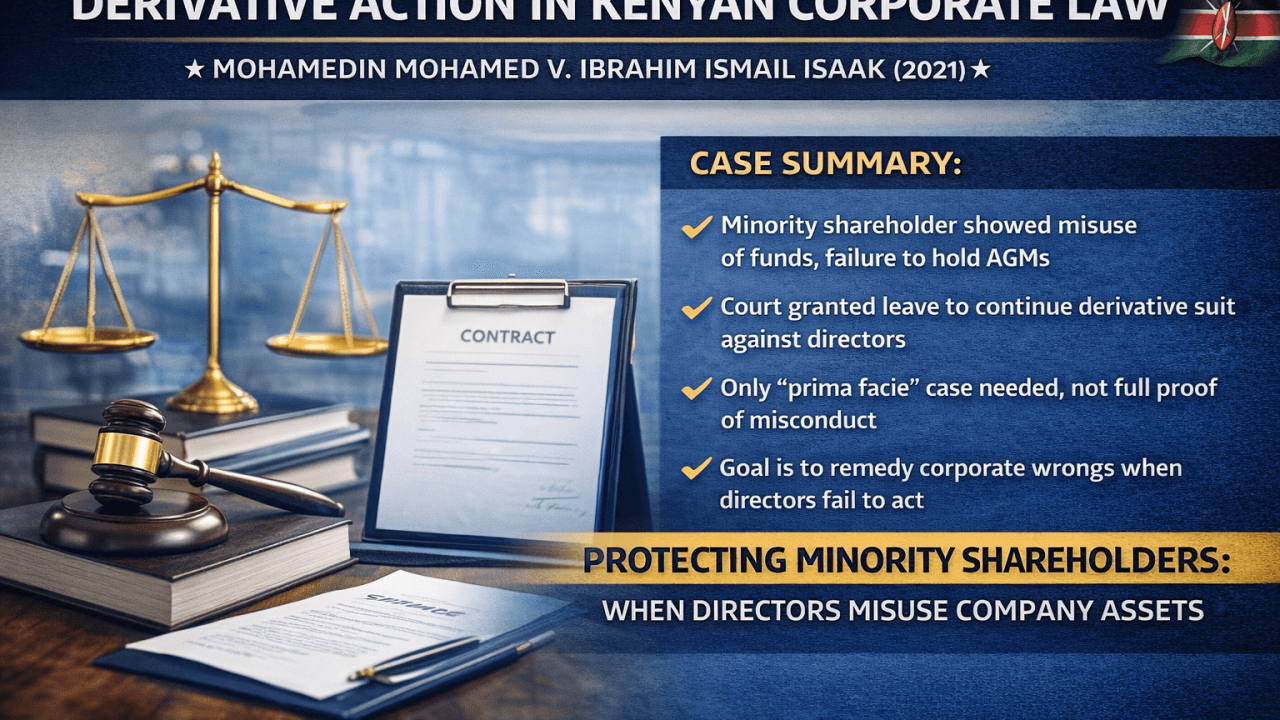
The case of Mohamedin Mohamed & another v Ibrahim Ismail Isaak & another (5) KEHC 7313 (KLR) is a good example. In this case, the Plaintiffs (minority shareholders) sued the Defendants (directors and majority shareholders) of Hish Company Limited. The minority shareholders alleged that the majority had:
- Failed to declare profits or pay dividends despite completing several projects.
- Failed to hold Annual General Meetings (AGMs) since 2018.
- Withheld financial records and audited accounts since 2015.
- Fraudulently siphoned company funds and misused company equipment for personal gain.
The court focused on the shift from the old common law rule in Foss v Harbottle (which generally prevented individuals from suing for wrongs done to a company) to the new statutory derivative action.
The court held that the Companies Act, 2015, fundamentally changed the law. The requirement to fit into specific common law exceptions was replaced by broad judicial discretion. The court's primary role now is to decide whether to grant permission (leave) for the suit to continue based on whether it is in the company's best interest.
The Defendants argued the suit should be struck out because the Plaintiffs did not seek the court's leave before filing the suit. However, the court took a substantive justice approach, ruling that:
- Leave can be sought after the suit has commenced.
- The court will not dismiss a genuine claim on a technicality if the company needs protection from delinquent directors.
The court found that the Plaintiffs had particularised their allegations of mismanagement and breach of duty. Since these allegations were not effectively controverted by the Defendants, they raised a prima facie case warranting a full trial.
This case is frequently cited for the principle that procedural technicalities (like the timing of a leave application) should not override the need to protect a company from insider abuse. It clarifies that a derivative action is a tool of accountability designed to ensure redress for the corporation, even when the wrongdoers are the ones in control of it.
2. Instances When the Courts Approve Derivative Claims
2.1. Scope of Section 238
Some of the instances when the court can approve a derivative action on behalf of the company include:
Section 238(3) of the Act limits derivative claims to key specific types of misconduct. A derivative cause of action can only be brought in respect of a cause of action which arises from default, negligence, breach of trust and breach of duty. Such a claim can be commenced against a director, or another person (a third party who assisted in the breach), or both. This claim can incorporate various remedies, like damages and equitable remedies like restitution, tracing, and accounting.
2.2. Specific Examples & Qualifying Instances
According to section 238 of the Act and various Kenyan cases (e.g., Mohamedin Mohamed v Ibrahim Ismail Isak and Isaiah Waweru Njumi v Muturi Ndungu), the following specific examples qualify for a derivative action:
- The Misappropriation of the Company Assets by the Directors and their Associates - When company directors divert or misuse company funds, assets or property to themselves or associated companies or individuals, then this justifies the bringing of a derivative action. This can happen when the company director uses company money to buy personal vehicles or even transfers company property, like company land or vehicles, to his associates or family.
- The Failure to Declare Dividends or Profits due to Fraud - Under the law, dividend policy is often the prerogative of the management and hence directors can choose whether to pay dividends or not. However, if the directors are diverting company profits and money so as to avoid paying dividends, then it will become a derivative claim. The court will not allow any derivative claim simply based on failing to declare or pay a dividend. A good case example is when the company directors allege that there was no profit made by the company, and yet the directors pay themselves very high consultant fees, which are equivalent to the profits which were made by the company.
- Breach of Fiduciary Duties under the Statute - Under sections 140–147, the law outlines the duties of the directors of the company. The law allows that such specific duties, when violated and the company refuses to pursue appropriate remedies because it is controlled by the wrongdoer directors, then a derivative action lies. This can occur when:
Conflict of Interest (Section 146): A director awards a lucrative supply contract to a firm they secretly own without disclosing the interest.
Promoting Success of the Company (Section 143): A director intentionally sabotages a company contract to help a competitor in which they hold shares.
d, Continued Failure to Sue a Third Party - If a third party breaches an agreement with the company, but the company directors reject or refuse to sue because they have a business or personal connection with that party, then a member is entitled to bring a derivative claim. An example here is when a contractor hired by the company fails to finish a company construction project, but the board of directors, being friends or related to the contractor, refuses to file or seek damages for breach of the contract. The minority shareholder can file for damages through a derivative cause of action on behalf of the company.
4. Case Law
In the decision of Ghelani Metals Limited & 3 others v Elesh Ghelani Natwarlal & another (6) eKLR states that:
“a mechanism which allows shareholder(s) to litigate on behalf of the corporation often against an insider (whether a director, majority shareholder or other officer) or a third party, whose action has allegedly injured the corporation.”
Thus, shareholders use derivative actions to bring accountability when the corporate governance structure fails.
In the case of Joseph Munyoki Nzioka v Raindrops Limited & 3 others (1) eKLR, the High Court has emphasised that a derivative action is a representative suit where the company is the true beneficiary of any relief granted. It held that. A derivative claim is one brought by a member of a company in respect of a cause of action vested in the company and seeking relief on behalf of the company. Minority shareholders have locus standi to sue where directors or majority shareholders engage in conduct involving negligence, default, breach of duty or breach of trust to the detriment of the company. The company will be made a party to the suit as the defendant.
This is the position as enumerated by Lord A.L. Smith in Spokes vs the Grosvenor and West End Railway Terminus Hotel Company Limited and Others and endorsed in the case of Joseph Munyoki Nzioka v Raindrops Limited & 3 others (1) KEHC 9387 (KLR):
“The proper plaintiff in such an action would obviously be the company; but in the circumstances existing, this is not possible for the impeached directors who have the controlling power in the company, do not assent to the company being made plaintiffs. To obviate this difficulty, it has for many years been the practice of the court of chancery in circumstances such as the present, to make the company parties to the action as defendants in which action the plaintiff shareholder asks for an order.
In the case of Sultan Hasham Lalji and 2 Others vs Ahmed Hasham Lalji and 4 Others (7) eKLR, it was held as follows:-
“It is the minority shareholders that are availed to the protection by the exceptions since generally majority shareholders exercise powers of the Company and control its affairs.”
Further in Altaf Abdulrasul Dadani Vs. Amini Akberazi & 3 Others, Nairobi (Milimani) Hccc No. 913 of 2002 (8) 1 KLR 95, Mwera, J (as he then was) stated as follows:-
“By derivative suits, the minority shareholders (s) feeling that wrongs have been done to the company which cannot be rectified by the internal company mechanisms like meetings and resolutions, because the majority shareholders are in control of the company, come to court as agents of the ‘wronged’ company to seek reliefs or relief for the company itself, all the shareholders including the wrong doers, and not for the personal benefit of the suing minority shareholders (s)….. it is a cardinal principle in company law that it is for the company and not the individual shareholder to enforce rights and actions vested in the company to sue for the wrongs done to it and in the absence of illegality a shareholder cannot bring these proceedings in respect of irregularities in the conduct of the company’s internal affairs in circumstances where the majority are entitled to prevent the bringing of an action in relation to such matters…. However if due to an illegality a shareholder perceives that the company is put to loss and damage but cannot bring an action for relief in its own name, such shareholder can bring an action by way of derivative action… mere irregularity in internal running of a company cannot be a basis for one to bring a derivative suit for such can be rectified by a vote/resolution at the company’s meetings and if a shareholder contemplates using a personal claim of infringement of his rights then a derivative suit will not avail as the relief must be for the benefit of the company…’’ (emphasis added).
4. Takeaway
4.1. the use of derivative action by shareholders
The derivative action stands as a critical tool for maintaining corporate integrity when those at the helm lose their way. It ensures that a company’s right to seek justice is not held hostage by the very individuals responsible for the harm. By prioritising the health of the business over rigid filing procedures, the law now provides a clear and accessible pathway for minority shareholders to step in as guardians of the corporation. Ultimately, this legal mechanism reinforces the idea that directors are accountable not just to their own interests but to the long-term survival and success of the entity they serve.
The court now functions as a balanced referee, filtering out personal vendettas while opening the door for genuine claims that serve the best interests of the business. This modern approach favours substance over form, meaning that a valid cry for help from a minority member will not be silenced by simple filing errors or procedural technicalities. At its heart, the law now treats accountability as a non-negotiable part of doing business.
4.2. Key Takeaway
- The company is the primary beneficiary. Even though a shareholder starts the legal process, any compensation or assets recovered belong to the business rather than the individual who filed the suit.
- Court permission acts as a gatekeeper. Shareholders must prove their claim is genuine and likely to succeed before the case can move into a full trial.
- Substance outweighs technicalities. Recent rulings confirm that minor procedural errors will not stop a valid claim from being heard if it protects the company from internal abuse.
- The focus is on business success. Judges use a specific test to determine if a responsible director would find the legal action helpful for the long-term future of the company.
- Good faith is non-negotiable. The court will quickly dismiss any case driven by personal grudges or hidden agendas rather than a sincere desire to help the corporation.
- All wrongdoers are reachable. A derivative suit can target directors and even outside parties who participated in the negligence or breach of trust.
Disclaimer: This publication is for general information only and does not constitute legal advice. Specific advice should be sought for individual circumstances.
Share this article
Need expert legal guidance on this topic?
Get In Touch