

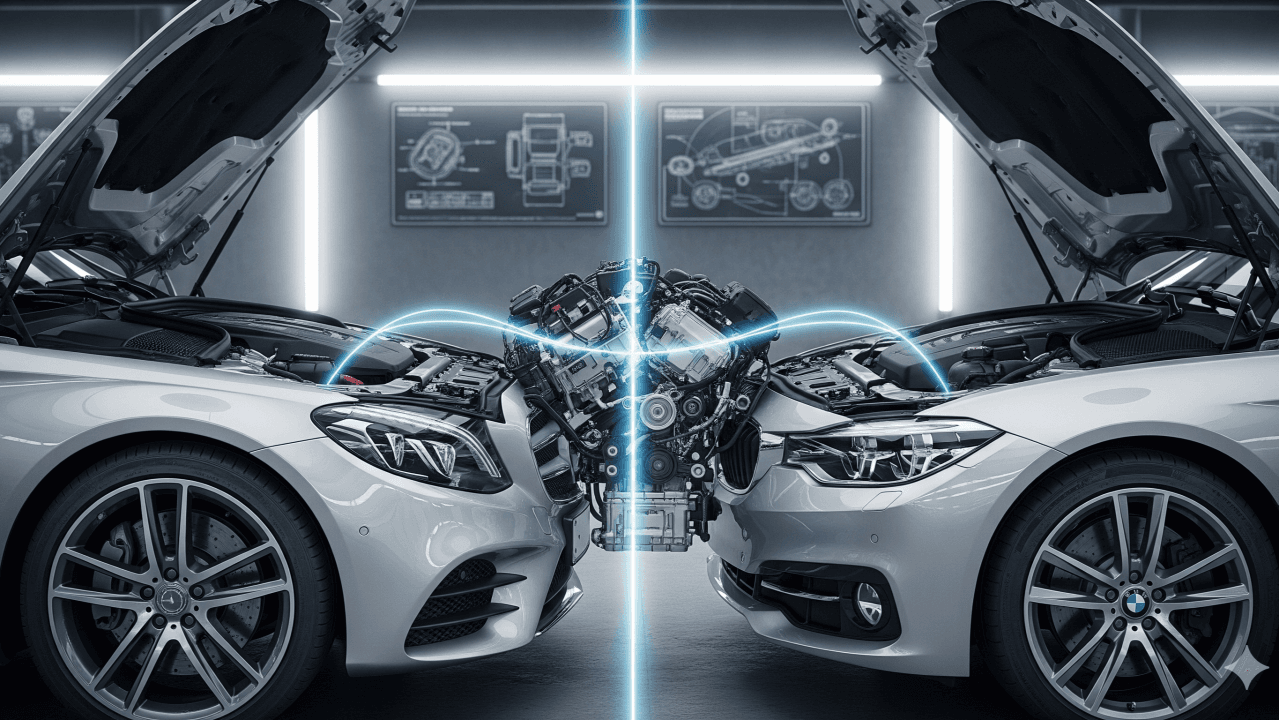
Why Mercedes Is Looking to BMW for Engines, How Regulation Influences Automotive Industry Trends

The regulation of the automotive engine sector
The automotive industry is one of the most heavily regulated in the world. For a vehicle or engine to be approved, it must meet strict requirements related to the environment, emissions, and safety. Regulations cover everything from CO₂ emissions and particulate limits to durability standards such as mileage.
These laws are becoming stricter with each update. For example, under Euro 7, cars must maintain a stoichiometric air-fuel mixture ratio (λ=1 or 14.7:1 for gasoline) throughout engine operation. The law also mandates three-way catalytic converters to reduce emissions like NOx and CO. Running rich increases CO emissions, while running lean creates more NOx particles.
To comply, manufacturers must invest heavily in improving ignition systems, engine timing, and fuel-air management. Unlike earlier standards, which allowed flexibility in mixture settings under certain conditions, today’s rules require precise controls and advanced technologies to achieve compliance.
These regulatory demands significantly raise development costs. Rising raw material prices and ongoing tariff disputes, particularly involving the United States and China, have further increased the financial burden. This has led many automakers to reconsider whether to develop engines in-house or outsource to specialised manufacturers.
Sourcing engines from external partners
To remain competitive, many carmakers have partnered with other manufacturers. Mercedes, for instance, has shared engines with Renault in its smaller models such as the A-Class, CLA, and GLA. Range Rover and Ineos have sourced engines from BMW, while Toyota’s Supra relies on BMW’s B58 powertrain.
Mercedes has also partnered with Geely to produce four-cylinder engines in China. However, these engines are often viewed as less compatible with advanced hybrid technologies when compared to BMW’s offerings. In addition, geopolitical factors and the perception of “Made in China” may dilute Mercedes’ premium image if such engines become widespread.
BMW’s history of making engines for other manufacturers
Against this backdrop, BMW stands out as a trusted source of high-performance and reliable engines. The company has a long history of supplying powertrains to other manufacturers. BMW engines have powered Formula 1 teams, the iconic McLaren F1 supercar with its naturally aspirated V12, and multiple generations of Range Rovers. More recently, BMW’s 4.4L twin-turbo V8 has been fitted in newer Land Rover models. Toyota, Morgan, and Ineos Grenadier also use BMW engines, demonstrating the company's versatility and reputation.
Some of the best modern engines are from BMW.
BMW’s engineering strength lies in both performance and adaptability. Its modular engines, such as the four-cylinder B48 and six-cylinder B58, are designed to meet future regulatory standards while supporting modern technologies, including mild hybrid systems, plug-in hybrids, start-stop functions, and even range extenders.
BMW’s B-series engines, which include the B38 3-cylinder, B48 4-cylinder, and B58 6-cylinder, are built on a modular architecture. This platform allows them to share common components and design principles across the different ranges. This family approach reduces development and production costs while ensuring consistent quality and performance. This means the B58 is essentially a B48 with two extra cylinders added, while the B48 itself can be seen as a four-cylinder expansion of the three-cylinder B38 (displacement ranging from 1.5L, 2.0L and 3.0L respectively. The advantage of this architecture is that components such as sensors, mounting points, transmission, and engine auxiliary parts like belts, AC pump, water pumps, serpentine belts, fans, and electronic and wiring can be shared with minimum changes across the range of engines. This saves costs and time in production. For example, BMW can use the same starter motor for its start-stop technology because of similar mounting points on the B48 and B54 engines, saving costs across its range of cars.
The B38 provides efficient power for smaller BMW and MINI models, the B48 offers a balance of strength and economy for mid-sized cars and SUVs, and the legendary B58 delivers refined performance for larger sedans and sports cars – mainly used in M performance models like the M240i and M340i.
Despite their differences in size and application, all these engines are designed to integrate with modern technologies such as range extending technology, mild hybrid systems and plug-in hybrids, a factor that makes these engines flexible enough to meet strict global environment and emissions regulations. This modular architecture enhances efficiency and adaptability across BMW’s lineup.
These engines can be mounted either transversely or longitudinally, making them suitable for a wide range of vehicles such as front-wheel-drive hatchbacks, xDrive SUVs, and rear-wheel-drive sedans. This flexibility has positioned BMW as a preferred engine supplier for brands seeking reliable and regulation-ready powertrains.
Will Mercedes Use BMW Engines?
This adaptability, performance, and flexibility of BMW engines are the key reasons Mercedes is rumoured to be exploring BMW powertrains for its future models. If talks progress, vehicles such as the CLA, GLA, GLB, C-Class, E-Class, and GLC could potentially adopt BMW’s four-cylinder B48 engine.
Such a collaboration would be remarkable given the decades-long rivalry between the two German automakers. It would also signal a shift in how traditional competitors cooperate under the pressures of regulation, cost, and electrification. While speculation currently centres on four-cylinder engines, future collaborations could expand to other powertrains.
Regardless of the outcome, the possibility of a Mercedes rolling out of the factory with a BMW engine highlights just how much the automotive landscape is changing. What was once unthinkable, with arch rivals sharing engineering resources, may soon become a practical solution in the face of global challenges.
All in all, one key denominator permeates the intended collaboration with BMW: environmental and emission regulations. Mercedes has to ensure that its engines are cleaner, have a mild hybrid system which aligns with modern regulatory requirements.
Disclaimer: This publication is for general information only and does not constitute legal advice. Specific advice should be sought for individual circumstances.
Share this article
Need expert legal guidance on this topic?
Get In Touch