

Shareholder Rights: Minority Shareholder Protection Under Unfair Prejudice Claims

Unfair and prejudice claim!
Minority shareholder disputes are often where corporate law stops being theoretical and becomes deeply personal. Behind the legal principles are real tensions, breakdowns in trust, and struggles over control, value, and fairness. While the rule of majority control remains central to company law, it is not absolute. The Companies Act, 2015, steps in to ensure that this power is not abused.
Minority shareholder protections are primarily anchored in the Companies Act, 2015 (“Act”), which modernised the legal landscape by codifying several common law principles established by the courts under English and Kenyan jurisprudence. These protections are aimed at balancing the "majority rule" principle with the need to prevent the abuse of power by directors who are sometimes the controlling shareholders or majority shareholders.
This article examines how the law protects minority shareholders through unfair prejudice claims, focusing on the balance between strict legal rights and the broader concept of legitimate expectations. It highlights how courts in Kenya have moved beyond rigid interpretations of company documents to uphold fairness in commercial relationships.
1. Protection from Oppression
Section 780 of the Act allows shareholders to seek court relief if company affairs are conducted in an "unfairly prejudicial" or "oppressive" manner. A member is allowed to petition the High Court if the company’s affairs are being conducted in a manner that is oppressive or unfairly prejudicial to the interests of some or all members.
According to the case of JM Mativo Justice in Velani & 6 others v Naran & 2 others (Petition E002 of 2020) (1) KEHC 75 (KLR) (Commercial and Tax) (21 September 2021) (Judgment):
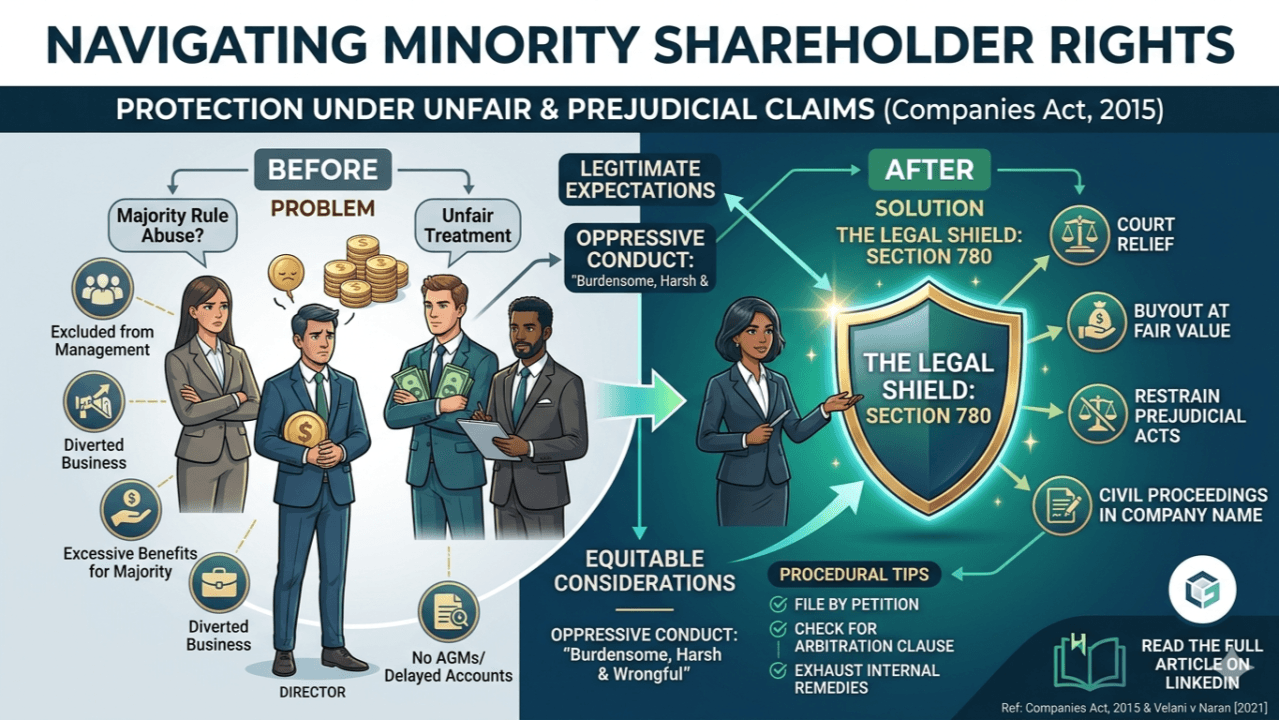
The categories of conduct which may amount to unfairly prejudicial conduct are not closed. However, common examples of what may constitute unfairly prejudicial conduct are:
a)exclusion from management in circumstances where there is a (legitimate) expectation of participation;
b)the diversion of business to another company in which the majority shareholder holds an interest;
c)the awarding by the majority shareholder to himself of excessive financial benefits; and
d)abuses of power and breaches of the Articles of Association. For example, the passing of a special resolution to alter the Company's Articles may be unfairly prejudicial conduct if such alterations would affect the Petitioner's legitimate expectation that he would participate in the management of the Company. Also, repeated failures to hold AGMs; delaying accounts, and depriving the members of their right to know the state of the Company's affairs may all be unfairly prejudicial to a member's interests.
(Paragraph 16)
Petitions for unfair prejudice often arise from internal corporate conflicts, such as disputes concerning shareholder representation on the board, the scope of management participation, executive compensation structures, and the contentious declaration or withholding of dividends. Furthermore, litigation frequently stems from complex inter-company dealings between subsidiaries and parent entities, as well as actions resulting in the dilution of a minority shareholder's equity, as seen in Ruo v Muthaiga Travel Limited & 4 others (2) KEHC 14558 (KLR). When grievances involve the conduct of directors, practitioners must exercise precise drafting to navigate the legal reality that directors’ duties are primarily owed to the company itself, requiring the petitioner to clearly articulate how those breaches have specifically resulted in unfair prejudice to their individual interests.
The Act allows a broad set of remedies under section 782. The court has discretion to issue remedies and orders such as:
- An order to regulate the company’s future conduct.
b)An order stopping the company from doing something or ordering the company to do something which the shareholders allege not to have been done.
- An order preventing the company from altering the articles without the leave of the court.
- An order of the majority (or the company) to buy out the minority’s shares at a fair value.
- An order issuing authorisation of civil proceedings in the name of the company.
- An order to restrain the company from performing certain acts.
Courts have held that "fairness" must be judged in the context of a commercial relationship, typically governed by the Articles of Association and any Shareholders' Agreements. However, the courts recognise that a shareholder's interest extends beyond strict legal rights to "legitimate expectations." In the case of Velani & 6 others v Naran & 2 others [2021] KEHC 75 (KLR), the court provided clarity on the standards of conduct:
"The words 'oppressive' or 'unfairly' enable the court to consider wider equitable considerations and recognise that the member has rights and expectations which are not necessarily included in the Articles of Association."
The same court further characterised oppressive conduct:
"Courts have characterised oppressive conduct as that which is burdensome, harsh and wrongful, or which lacks probity and fair dealing."
2. Form of Application
In John Muturi Nyaga v Graham Alexander Walsh & 3 Others (3) eKLR, Tuiyott J held that an application under Section 780 should be by way of a petition (rather than a motion) to allow for the substantive interrogation of the applicant’s grievances.
The form of the petition is provided under section 994(1) of the \English Companies Act 2006. A filing by way of plaintiff is also allowed, but a party cannot file a miscellaneous application. This is because such a filing does not allow the court to address and interrogate the grievances in full.
3. Role of the Court
Section 780 allows for intervention even where the rule in Foss v Harbottle would typically discourage courts from interfering in the internal management of a company. The court confirmed that it has the power to intervene when affairs are conducted in a manner that is harsh or "prejudicial.
The court is expected to uphold the equitable expectation of the shareholders. These expectations can be found in the articles and shareholder agreements. According to the decision of Velani & 6 others v Naran & 2 others (Petition E002 of 2020) (1) KEHC 75 (KLR) (Commercial and Tax) (21 September 2021) (Judgment), the courts are allowed to find that members have expectations and rights beyond the articles. This is because the words unfair and oppressive give wider equitable considerations.
4. Arbitration
The courts have shown that they will respect arbitration clauses found in a company’s Articles of Association. In Lettau vs Paradiso Toys Limited & another (Commercial Petition E002 of 2023) (2) KEHC 3793 (KLR), the court stayed proceedings and referred the matter to arbitration because the Articles contained a mandatory arbitration clause.
5. Exhaustion of Internal Remedies
While Section 780 is a powerful tool, courts generally expect that shareholders have attempted to resolve the dispute through internal mechanisms (like board meetings or AGMs) unless such attempts would be futile.
The evolution of minority shareholder protection in Kenya reflects a shift from rigid adherence to internal management rules to a more nuanced, equitable approach. While the landmark rule in Foss v Harbottle originally limited judicial interference in company affairs, the Companies Act, 2015, and recent High Court jurisprudence, such as Velani v Naran, make it clear that "fairness" is the ultimate benchmark. By balancing legal rights with equitable expectations, the law ensures that minority shareholders are not merely silent partners but protected stakeholders in the corporate enterprise. For practitioners and shareholders alike, the key to success lies in precisely articulating how majority actions result in individual prejudice while navigating the procedural preferences for petitions and arbitration.
6. Key Takeaways
- Legal Foundation: Minority protection is primarily anchored in Section 780 of the Companies Act, 2015, which allows shareholders to petition the court for relief against oppressive or unfairly prejudicial conduct.
- Broad Interpretation of Misconduct: Conduct warranting court intervention is not strictly defined but includes exclusion from management, diversion of business, excessive financial benefits for the majority, and failure to hold AGMs.
- Legitimate Expectations: Courts look beyond the formal Articles of Association to consider "equitable considerations," protecting a shareholder’s reasonable expectations even if they aren't explicitly written in the company's bylaws.
- Range of Remedies: Under Section 782, the court has wide discretion to order remedies, ranging from regulating future conduct and restraining specific acts to the "nuclear option" of forcing a buyout of the minority’s shares at fair value.
- Procedural Specifics: Grievances must be filed as a petition rather than a motion to allow for a substantive interrogation of the facts. However, courts will generally respect arbitration clauses if they are included in the company's Articles.
- Internal Resolution First: While the court has the power to intervene, shareholders are typically expected to exhaust internal remedies (like AGMs or board meetings) unless doing so would be clearly futile.
Disclaimer: This publication is for general information only and does not constitute legal advice. Specific advice should be sought for individual circumstances.
Share this article
Need expert legal guidance on this topic?
Get In Touch