

What Is “Open Source”? What to Look Out for When Using Open-Source Code

Introduction
Open source refers to a legal licensing model for software or firmware (and increasingly, other types of digital content) that allows users to freely access, use, modify, and share the source code or content—subject to specific conditions set out in an open-source license.
Open sources do not mean the public domain. One must read the open-source licensing agreement carefully when opting to use open-source code. There may be conditions that, when ignored, may lead to legal consequences.
Definition and Practical Implications
Open-source software is distributed under a license that has:
- Granted users the freedom to run the software for any purpose (or specific purposes outlined in the open-source licensing agreement)
- Allows access to the source code
- Permits modification and distribution of the software
- May require attribution or preservation of the same license in derivative works
Types of Licenses
There are different types of open licenses. The type of licenses varies depending on the conditions imposed by the creator. These conditions are defined by open-source licenses such as:
MIT License
These are very permissive. They allow a user to use, copy, modify, merge, publish, distribute, sublicense, and sell the software. The condition is that there should be inclusion of the original copyright notice and licensing text in a copy or a substantial portion of the software.
This license is very flexible and does not require one to open-source the changes made to the software. The licensing allows the use of the code alongside proprietary software without risks. For instance, this allows integration of the code with proprietary software and code.
For MIT, a user is not required to disclose any derivative works or changes to the open-sourced code. This option is suitable for users who may wish to combine open source with proprietary code or software.
This license does not have any provisions relating to patents. Even though the terms of the copyright are permissive, the contributor can sue someone who used the code under MIT for patent infringement. This creates ambiguity in the manner in which MIT interacts with patents.
GNU General Public License (GPL)
This is a copyleft license created by the Free Software Foundation (FSF). A copyleft license is a type of open-source license that allows users to freely use, modify, and distribute a work. However, there is a requirement that any modified or extended versions of the work are also shared under the same license terms. When a user makes modifications, they are to publish their modifications or share the modifications based on the conditions.
Unlike MIT and Apache 2.0, GPL mandates that any software that is derived from GPL-licensed code must also be licensed under the same model. Hence, if you use any GPL-licensed code (modify or combine it) with your code, you are mandated to release the new code that you create under GPL. This release should include the source code and make continued use, updates, and development possible. A user cannot sue someone else for using GPL-covered software if the user contributed to the code.
The main principle is that you can use the code freely, but once you finish building on the code, you are required to share and give others the same freedom that you were given. Hence, derivative works must be disclosed, and it must be ensured that the software or code remains open and free for future users.
The legal enforcement under the GPL is done under the license terms and copyright law. A creator of open-source code can enforce the terms by mandating a user to publish and share any code and software derived from the open-source code.
This type of license is suitable for developers who wish to have their software remain open source for all in the future.
This licensing is not ideal when a user wishes to combine the proprietary code with open-source code. The licensing can be better used in Kenya for university and research projects, government and technology development using public finance, social good, and civil technology programs.
Apache License 2.0
This is a license that is a permissive open-source license developed by the Apache Software Foundation (ASF), but it has stronger protection for patents and contributions. It allows users to use, modify, and distribute freely. It also allows use alongside proprietary software. The conditions that must be met by a licensee include
- Must include a notice of any changes made to the free code.
- Must preserve the original license and copyright.
- Includes an express grant of patent rights to contributors.
The main legal point to factor in is that it offers strong protection against patent claims. Hence, this is more comprehensive when compared to MIT. This license is suitable for commercial projects where there is a keen concern to retain freedom to use open source with limited legal risks.
Any users and contributors automatically allow other users the license to use any patents they hold that are related to the software. When a user sues someone over a patent infringement on software, they automatically lose the license to use the software.
Creative Commons (CC) Licenses (for Content, Not Software Code)
This licensing works for content such as designs, articles, videos, and photos. The license varies depending on various factors. Based on the license, it allows use, sharing, remixing, and even commercial use. The different types are as follows:
- Attribution (CC BY)
Here, the licensing allows one to copy, distribute, remix, adapt, and build upon the work—even for commercial use. The only condition is that the user must give proper credit to the original creator of the work. This is mainly used in blogs, written content, videos, or educational materials that want to reach a wide audience. It is a flexible licensing framework as long as the user gives credit.
- Attribution-ShareAlike (CC BY-SA)
This licensing allows the same type of freedoms that are given to a user in a CC VY licensing. The user is thus able to copy, modify, distribute, and use commercially. Under this licensing model, a user must credit the creator, and any derivative work is shared under the license (ShareAlike). The best example is collaborative work like Wikipedia. It has the advantage of ensuring that all future versions and updates remain open and free.
- Attribution-Non-Commercial (CC BY-NC)
This is a license that only allows users to copy, modify, and share the work as long as the same is not done commercially. The user must credit the original creator under this license. Hence, the major disadvantage is that users cannot commercially exploit the work; hence, selling, ads, or monetisation of content is not allowed.
Common examples include student projects, educational tools, and nonprofit materials.
- Public Domain Dedication (CC0)
Here, there is no restriction at all. A user can copy, modify, share, and use the work. Both personal and commercial exploitation of work is allowed without giving credit. This licensing model is only possible when the creator has waived all his or her rights, and hence it is the licensing that mirrors or is close to the public domain.
Legal Framework for Open-Source Licensing in Kenya
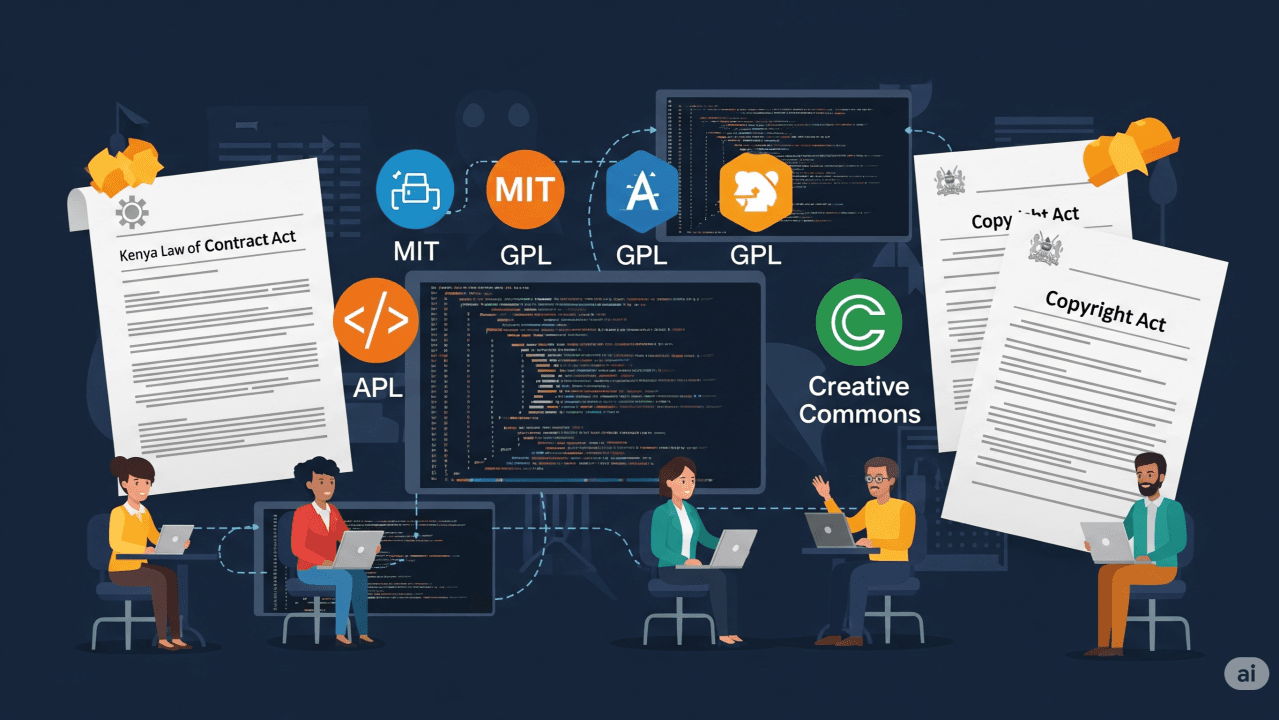
The legal framework for open-source falls under the law of contract. Enforcement of open-source licenses would be regulated under the Law of Contract Act (Cap. 23, Laws of Kenya), which governs contracts, and the Copyright Act, 2001 (Cap. 130), which protects digital works and software.
Developers in Kenya need to be cautious when using open source. A full understanding of the licensing obligations will ensure that the developers have a firm understanding of GPL restrictions and the requirement to attribute.
There may also be the issue of mixing open-source code with proprietary code. Before doing this, it is important to ensure that there is legal clarity. For example, ascertaining that there is no requirement to publish and share derivative work is one of the things that a business can consider.
Conclusion
Open-source licensing offers powerful opportunities for innovation, cost-efficiency, and collaboration, but only when used responsibly and with full legal awareness. Each license, from MIT to GPL to Apache 2.0, comes with specific obligations that affect how you can use, modify, distribute, or commercialise the code.
In Kenya, developers, businesses, and institutions must treat open-source licenses as binding legal agreements. Misunderstanding or ignoring license terms, such as attribution requirements, share-alike conditions, or patent clauses, can expose users to legal risks, including breach of contract or copyright infringement.
Before integrating open-source code into your project, especially in commercial or proprietary settings, carefully review the license terms. Choose licenses that align with your development goals, whether you want to keep your code open (like GPL), maintain flexibility (like MIT or Apache), or avoid legal uncertainties around patents.
Ultimately, open-source code is a powerful tool, but like any legal asset, it must be used wisely. Legal due diligence, clear attribution, and awareness of license compatibility will ensure that your software projects remain both innovative and compliant.
Disclaimer: This publication is for general information only and does not constitute legal advice. Specific advice should be sought for individual circumstances.
Share this article
Need expert legal guidance on this topic?
Get In Touch